

01
Client portals
We build portals for customers, employees and partners, with authentication, user roles, data access, requests, transaction history and self-service features tailored to the project.
Python Web Services
We design and build web applications for businesses, including client portals, B2B platforms, APIs and internal systems. Our solutions automate workflows, handle data and connect existing services. We choose an architecture around your company’s real needs and plans for future growth.
From business analysis and system design to development, launch and support.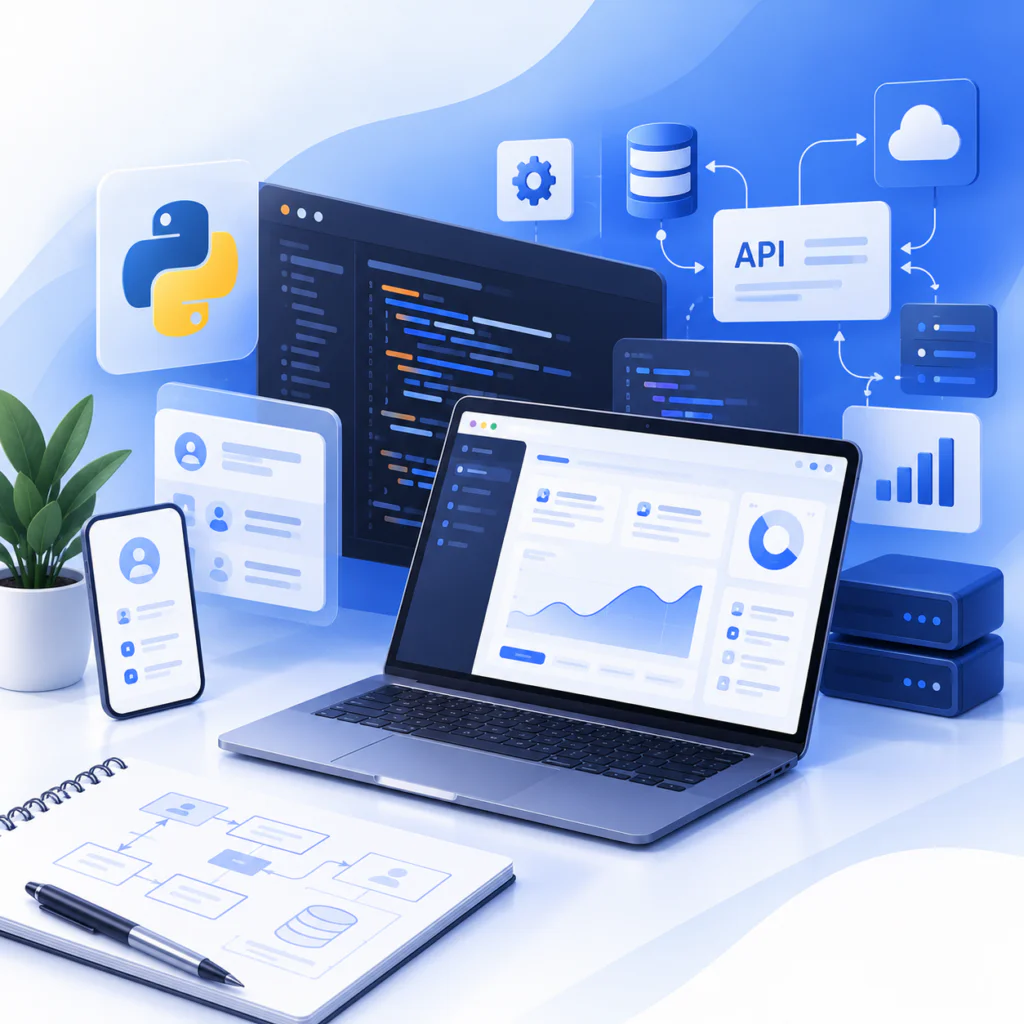
Getting started
You do not need to choose a programming language, database or server architecture before asking us to build a web application. The important thing is to explain what the system should do, who will use it and which processes need to be automated.
At the start, we review the requirements, existing tools and how data is handled. This helps us define the first version’s features, the integrations it needs and a sensible development sequence.
We identify the process to improve, whether that is handling enquiries, serving customers, exchanging data, internal record keeping, managing orders or coordinating employees.
We identify who will use the application: customers, managers, administrators or partners. For each role, we define the actions and information available to them.
We discuss the data the system needs to store and process, and whether it must connect to a CRM, website, database, external API or other tools.
We separate essential features for the first release from options for future development, and discuss constraints, target dates and an indicative budget.
Tell us about the current challenge. We will help identify automation opportunities and outline the system you need.
01. 01. What we build
Not every business challenge can be solved with a standard website or CRM. When a project needs custom logic, data processing and interaction between multiple systems, we build a tailored web application with Python.
01
We build portals for customers, employees and partners, with authentication, user roles, data access, requests, transaction history and self-service features tailored to the project.
02
We create web tools for managing tasks, enquiries, orders and internal workflows. A unified system can replace scattered spreadsheets and manual operations.
03
We develop APIs and backend components that exchange data between applications. We connect external systems and implement request handling, access rules and agreed business logic.
04
We design private platforms for working with partners and corporate customers. Depending on the project, they can include individual accounts, catalogs, orders, status tracking and access controls.
05
We build applications for recurring tasks such as data transfer, report generation, notifications, approvals and other business workflows.
06
We develop web applications with custom logic, from an initial working product to an extensible service with users, data, integrations and an admin area.
02. 02. Our approach
Web application development begins by examining the process you want to improve. We identify the users, roles, data and sequence of actions, then design the architecture and interfaces around the business challenge.
A considered structure makes it easier to add features and integrations over time. We avoid unnecessary complexity and choose technical solutions to suit the scale and requirements of each system.
We design workflows around what employees and customers actually do. Automation should make a process simpler, not create extra steps people have to follow.
We create clear screens, forms, tables and admin panels, accounting for the different roles and tasks in the system.
We plan a structure that can support new features, connected services and a larger system as requirements evolve.
03. 03. End-to-end development
A web application project can include requirements analysis, architecture and interface design, backend logic, data handling and integrations. The stages depend on the system’s complexity, user base and required features.
We review the business challenge, current workflows, users and project constraints. We define functional requirements and priorities.
We outline the main modules, user roles, workflows, data flows and connections to external systems.
We plan screens, tables, forms, navigation and key actions so the logic can be agreed before development begins.
We implement server-side logic, request handling, access rules, database interactions and the required APIs.
We build interfaces for users and administrators around the agreed workflows and responsive design requirements.
We connect external systems and services through their available APIs, configure data exchange and handle possible integration errors.
We check features, user permissions, data handling and key workflows, prepare the production environment and launch the system.
If needed, we maintain the application, fix issues, add features and improve integrations.
04. 04. The team
A successful web application needs development, interface design and an understanding of user needs. The Bravix team is assembled around the system, its features and required integrations.

Development
Builds modern websites, bots and web applications for business needs.

SEO
Improves search visibility and helps websites grow their organic traffic.

Advertising
Sets up advertising campaigns to reach relevant audiences and generate enquiries.

Visual Content
Creates photography, video and visual content that reflects a brand’s character.
05. 05. How we work
We work through the project in sequence, from understanding the business challenge to launch and future improvements. The timeline depends on features, integrations and project requirements.
01
01
We discuss business goals, existing tools, users and the results you expect.
02
We design system modules, data structures, user roles and key integrations.
03
We plan user workflows and agree on the structure of the application’s screens.
04
We build the backend logic, interfaces, database and required integrations.
05
We check features, user permissions, error handling and system behaviour.
06
As needed, we add features, improve workflows and maintain the application.
06. 06. Our experience
The Bravix portfolio includes related digital projects, such as the Reserv booking website and online stores. These are real web projects, not examples of Python applications.
A product website for a restaurant booking and guest seating management service.
An online store for tools and equipment, built around a carefully planned product catalogue.
An online paint and coatings store with an easy-to-use catalogue and ordering process.
A corporate website for an industrial equipment manufacturer.
07. Technology and architecture
Python can power the backend of web applications, implement business logic, process data and provide APIs for other systems. We choose an architecture around the project’s needs, access requirements and expected workload.
Depending on the project, we select suitable tools for development, data storage, background tasks, integrations and deployment. The goal is not to use technology for its own sake, but to build a reliable system that can be maintained.
System components
08. 08. Questions and answers
The cost depends on the number of features, business logic, user roles, interfaces and integrations. A small internal tool and a feature-rich online platform require different amounts of work. After discussing your needs, we define the project scope and prepare a tailored estimate.
The timeline depends on the features, architecture, interface requirements, integrations and testing. For a complex project, we can define an initial working release with priority features. We agree on a schedule after reviewing the requirements.
A regular website mainly presents information, products or services. A web application usually supports more involved user actions, such as working with data, using client accounts, managing roles, automating processes or connecting systems. The distinction depends on the project’s needs.
Yes, if the external system provides a suitable integration interface and the required access. We determine how it can connect after reviewing the API, data structure and information exchange requirements.
Yes. Depending on the project, a client portal can include user profiles, documents, order history, requests, status updates and other features. Different access rights can be set for different user roles.
Yes. For some projects, it makes sense to start with a minimum working version, validate how it is used and expand it later. We define the MVP scope during planning.
For the backend, we may use Python and tools from its ecosystem. We choose a framework, database and deployment approach based on the project requirements, existing infrastructure and integrations.
Yes, after reviewing the source code, dependencies, documentation and current architecture. We first assess the system’s technical condition and the risks of making changes, then estimate the work.
Hosting depends on availability, workload, data processing and your infrastructure requirements. The application may run on a suitable server or cloud platform. We agree on the environment separately.
Yes. With a suitable architecture, we can add modules, user roles and integrations. We plan changes around the existing code, data and your business needs.
09. Other services

We build WordPress websites for businesses, including corporate sites, landing pages, catalogs and online stores. We plan the structure and design, and make content easy to manage.

We build Telegram bots to handle enquiries, send notifications and automate business tasks. Integrations are selected to work with the systems you already use.
We set up and maintain server infrastructure, automate application deployment, and manage monitoring, updates and backups.
We design and select server infrastructure for businesses, taking workloads, virtualization, data storage, reliability and future growth into account.
We improve website visibility through technical audits, site structure and content optimization, and analysis of search performance and organic traffic.
We develop social media strategies, create content and manage business accounts. We help brands connect with their audiences and track engagement.
We set up and manage paid search campaigns: researching keywords, preparing ads, tracking enquiries and optimizing campaigns around your budget.
We design UI/UX for websites, web applications and mobile apps. Our work includes prototypes, visual concepts and design files ready for development.
We create visual brand identities, including logos, color palettes, typography and graphic elements, and prepare brand guidelines and brand books.
We create commercial photography for websites, advertising and social media, covering products, teams, work processes and business spaces.
We produce advertising, corporate and product videos for businesses, helping with concepts, scripts, filming and editing.