

01
Enquiry and sales bots
Collect enquiries, clarify customer needs, help people choose a product or service, and pass requests to managers. These bots can automate the first steps of the sales process.
Telegram Bots for Business
We build Telegram bots around your company’s needs, automating enquiries, sales, bookings, customer support and internal workflows. We plan conversation flows, connect the required services and develop features that reduce manual work and make it easier to serve your customers.
From the initial idea and conversation flow to launch, integrations and ongoing development.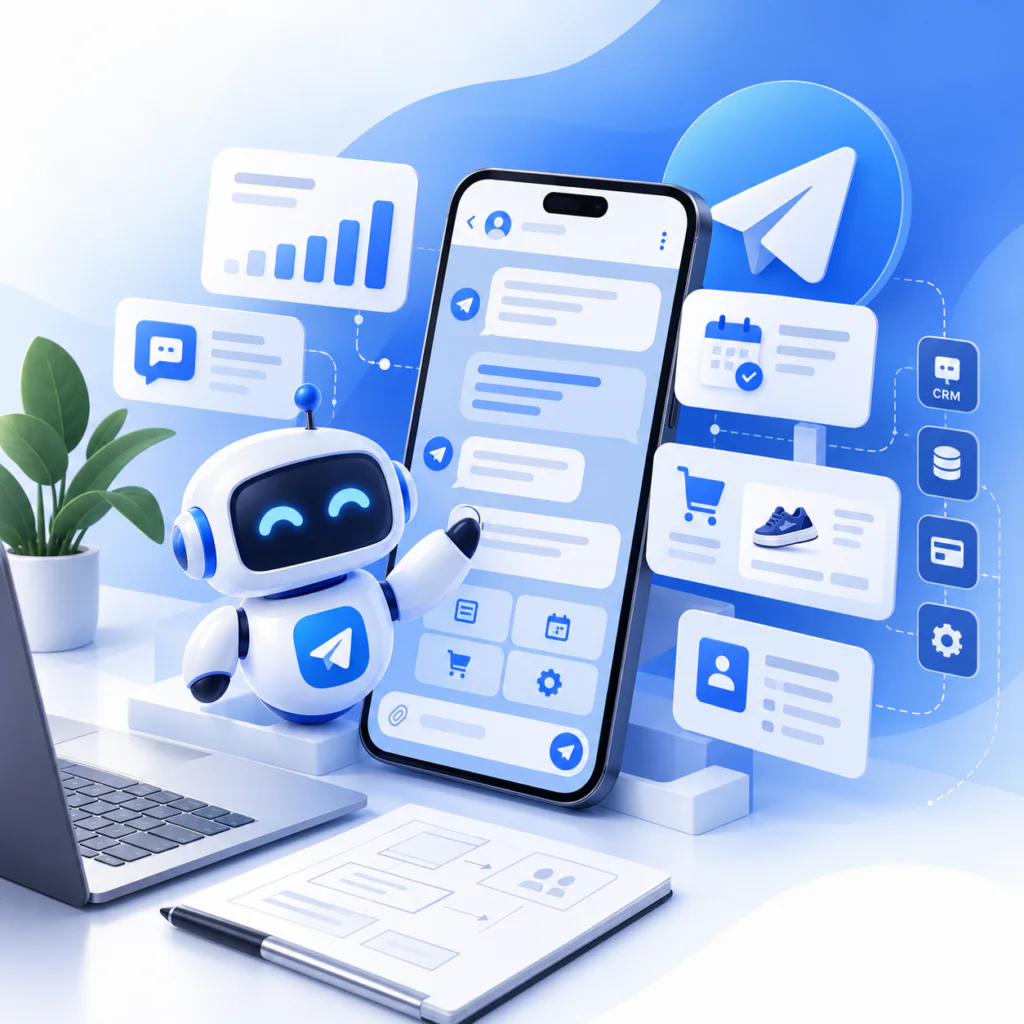
Getting started
You do not need to document every command and conversation flow before asking us to build a Telegram bot. Tell us which tasks are handled manually, how customers interact with your company and what you want to achieve. We will help define the bot’s logic and features.
At the start, we identify what the bot should handle on its own, when a conversation should be passed to a team member and which systems need to exchange data. This helps us design a solution around your actual business processes.
We define what the bot should do: receive enquiries, help customers choose a service, book appointments, process orders, send notifications or handle internal team tasks.
We plan the sequence of questions, buttons and actions. We account for different user responses, errors, returning to previous steps and handing complex questions to a manager.
We find out whether enquiries need to go to a CRM, data needs to come from a database, or the bot needs to connect to payments, a calendar, a website or other services.
We discuss the expected number of users, data storage requirements, how the bot will be managed and how its features may need to grow.
Describe the process you want to improve. We will help define the right flow and scope of work.
01. What bots can do
A Telegram bot can be a simple assistant with a few flows or part of a more complex business system. We choose features to fit your company’s needs and can connect the bot to a CRM, website, payment service and other systems.
01
Collect enquiries, clarify customer needs, help people choose a product or service, and pass requests to managers. These bots can automate the first steps of the sales process.
02
Answer common questions, help users find information, provide updates on requests and hand a conversation to a team member when needed.
03
Let users choose a service and an available time, then make a booking. The bot can send confirmations and reminders and, when integrated, sync with a scheduling system.
04
Send enquiries and contact details to a CRM, retrieve information from external systems and notify users about events. These bots connect Telegram with your company’s existing workflows.
05
Let users browse an offer, place an order and continue to payment. The payment flow depends on the product, available payment methods and platform requirements.
06
Automate staff notifications, information gathering, approvals, internal requests and other recurring tasks. We tailor the flow to how your team works.
02. Our approach
A Telegram bot is effective when its flows reflect the company’s real needs, not when it has the most commands. We start by understanding the process: what the user needs to do, which information the bot must collect and when a team member should step in.
From there, we design the conversation logic, integration points and handling for less common situations. This makes it possible to develop the bot gradually without turning it into a confusing menu of commands.
Users should quickly understand what the bot can do and how to get the result they need. We plan navigation, messages, buttons and error handling.
We automate recurring tasks such as initial data collection, common answers, notifications and other actions that do not need a manager’s constant attention.
Within the agreed scope, we connect the bot to CRMs, websites, databases and external APIs so information does not stay isolated in a chat.
03. End-to-end development
Telegram bot development can include planning user flows, programming, integrations and testing. The scope depends on the bot’s logic, features, connected services and operational requirements.
We review the business process, users and automation goals. We define what the bot should do and which data it needs to handle.
We map dialogues, menus, buttons, transitions and messages. We plan what happens when an error occurs or a request needs a team member.
We determine what data needs to be stored, how the bot will communicate with external systems and which technical constraints to account for.
We implement commands, message handlers, user states, access rules and the agreed business logic using the Telegram Bot API.
We connect the agreed external services, such as CRMs, databases, websites, notification systems or payment providers, using their available APIs.
We check user flows, invalid input, repeated actions, integration errors and data transfer.
We configure the production environment, Telegram connection and operational settings, then check the bot after launch.
If needed, we support the project by fixing issues, updating integrations, adding flows and adapting features as business processes change.
04. The team
Telegram bot development takes more than programming. It also requires an understanding of user flows, interfaces and business processes. We bring in specialists to match the needs of each solution.

Development
Builds modern websites, bots and web applications for business needs.

SEO
Improves search visibility and helps websites grow their organic traffic.

Advertising
Sets up advertising campaigns to reach relevant audiences and generate enquiries.
Visual Content
Creates photography, video and visual content that reflects a brand’s character.
05. How we work
We work through the project step by step, from discussing your goals to testing and launch. The timeline depends on the number of conversation flows, integrations and required features.
01
01
We learn about your business needs, audience and the main ways people will use the bot.
02
We define commands, conversations, user states and integration requirements.
03
We agree on the key interactions and the structure of the user journey.
04
We build the bot’s features, configure handlers and connect the required services.
05
We test flows, errors and integrations, then deploy the bot to its production environment.
06
After launch, we can add features and help keep integrations running as needed.
06. Our experience
Our projects involve user interfaces, content management systems, enquiries and integrations. This experience helps us design Telegram bots as part of a business’s wider digital setup.
An online store for tools and equipment, built around a carefully planned product catalogue.
An online paint and coatings store with an easy-to-use catalogue and ordering process.
A corporate website for an industrial equipment manufacturer.
A detailing centre website presenting services and making it easy for customers to get in touch.
07. Technology and integrations
A Telegram bot can do more than operate as a standalone chat: it can provide an interface to your existing business systems. The Telegram Bot API supports user flows, incoming messages, command handling and data exchange with an application’s backend.
Depending on the project, the bot can send enquiries to a CRM, access a database, retrieve information from a website, send notifications or communicate with external services through APIs. We agree on the architecture and integrations during planning.
Data transfer
08. Questions and answers
The cost depends on the complexity of the conversation flows, number of features, data storage requirements and external integrations. A simple enquiry bot and a system connected to a CRM and payment service involve different amounts of work. After discussing your needs, we define the scope and prepare a tailored estimate.
The timeline depends on the number of flows, business logic and connected systems. A small bot with a menu and enquiry form takes less work than a service with payments, CRM and multiple user roles. We agree on a realistic schedule after reviewing the requirements.
Yes, if your CRM provides a suitable API or another supported integration method. The bot can send enquiries, contact details and other agreed information. The exact flow depends on the CRM’s capabilities and your business needs.
Payment options depend on the products or services, available payment solutions and current Telegram requirements. We can plan a suitable flow during design and select an integration method for the project.
No. A Telegram bot can operate as a standalone channel. If needed, it can also connect to an existing website, CRM, database and other systems used in your business.
Yes. We can build answers to common questions, service navigation, information collection and other defined flows. For complex requests, it is best to include a way to hand the conversation to a team member. AI features can be discussed separately if standard flows are not enough.
Tell us who will use the bot, what it should do and which services it needs to connect to. We will help define the flows and feature requirements.
Yes, if its source code, configuration and necessary technical documentation are available. We first review the implementation, dependencies and constraints, then assess how it can be updated safely.
Bots with their own server-side logic usually need a runtime environment, such as a server or suitable cloud platform. Hosting requirements depend on the architecture, workload and integrations. We discuss operations as part of the project.
Yes. With a suitable architecture, new flows, user roles, integrations and other features can be added. We plan further development around the existing code and your business needs.
09. Other services

We build WordPress websites for businesses, including corporate sites, landing pages, catalogs and online stores. We plan the structure and design, and make content easy to manage.

We develop Python web applications, including client portals, B2B platforms, APIs and internal systems. Each solution is designed around your business processes.
We set up and maintain server infrastructure, automate application deployment, and manage monitoring, updates and backups.
We design and select server infrastructure for businesses, taking workloads, virtualization, data storage, reliability and future growth into account.
We improve website visibility through technical audits, site structure and content optimization, and analysis of search performance and organic traffic.
We develop social media strategies, create content and manage business accounts. We help brands connect with their audiences and track engagement.
We set up and manage paid search campaigns: researching keywords, preparing ads, tracking enquiries and optimizing campaigns around your budget.
We design UI/UX for websites, web applications and mobile apps. Our work includes prototypes, visual concepts and design files ready for development.
We create visual brand identities, including logos, color palettes, typography and graphic elements, and prepare brand guidelines and brand books.
We create commercial photography for websites, advertising and social media, covering products, teams, work processes and business spaces.
We produce advertising, corporate and product videos for businesses, helping with concepts, scripts, filming and editing.