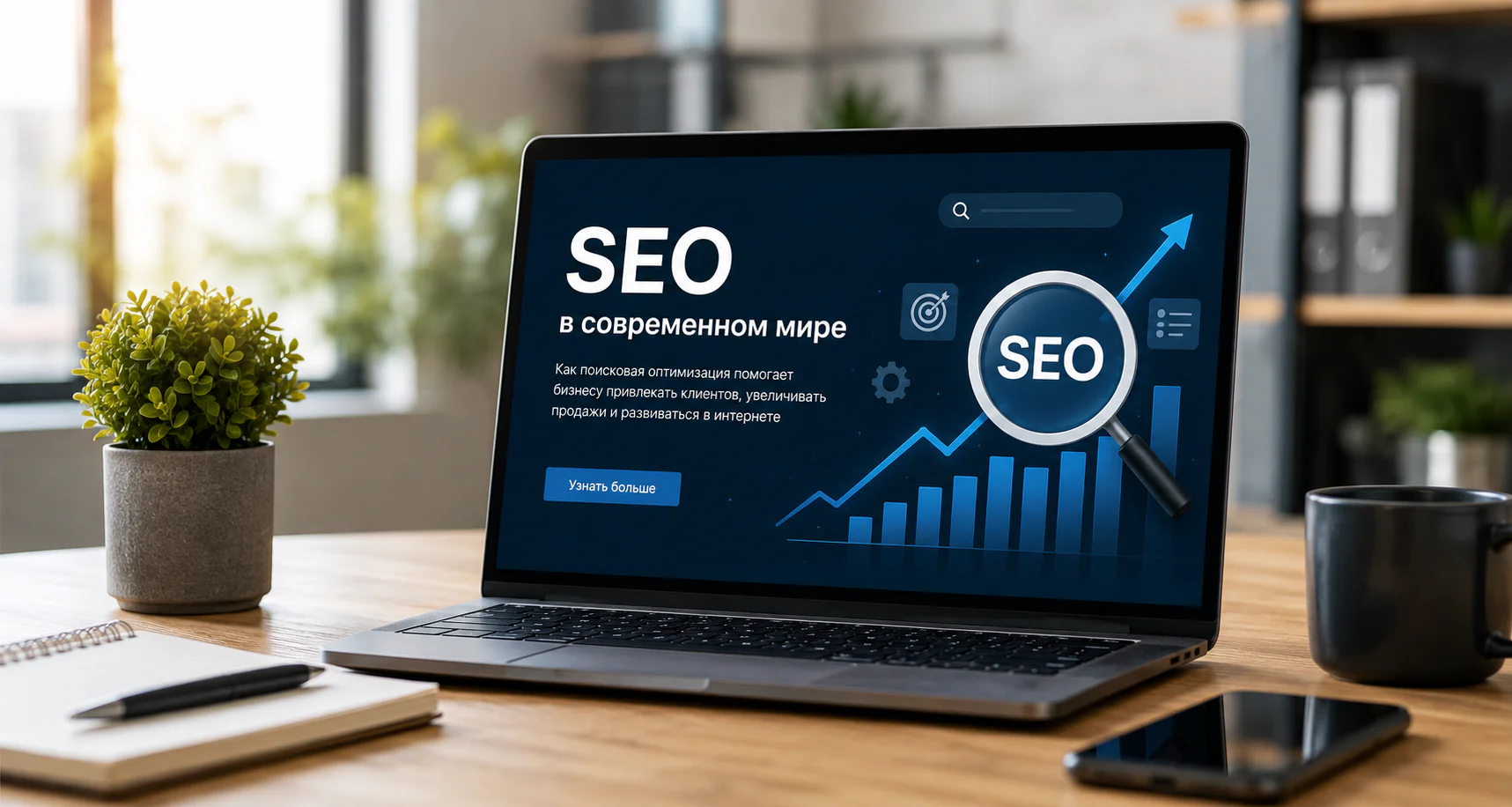
1. Why SEO matters to modern businesses
The internet is now one of the main places people turn to for information about products, services, and companies. Before contacting a business, ordering a service, or making a purchase, potential customers often start by searching. They enter a query, compare offers, explore company websites, and read service descriptions before deciding.
Simply having a website is no longer enough. A modern design, detailed company information, a product catalogue, and a convenient contact form all have limited value if potential customers cannot find the site through search engines.
SEO, or search engine optimisation, addresses this challenge. It makes pages easier for search engines and people to understand, improves their presence in search results, and attracts audiences already interested in particular information, products, or services.
Modern SEO is not a single technical setting or a matter of adding keywords. It involves the website as a whole: its structure and content, speed and technical health, usability, internal links, headings, metadata, and the quality of individual pages.
The value of search promotion lies in reaching potential customers when they already have a need. A person describes a problem and looks for a solution. If a company appears among relevant results and provides useful information, an ordinary search can become a first encounter with the brand, an enquiry, and eventually a sale.
SEO matters especially in competitive markets, where people can choose among dozens or hundreds of companies. If a business has little presence in search, competitors may capture much of the potential demand.
Search optimisation is therefore a long-term digital asset. By developing its website, a business improves its online visibility, content, customer experience, and overall competitiveness.
SEO helps a business appear when a potential customer is searching for a product, service, specialist, or solution. Good optimisation turns a website from a simple online brochure into a channel for reaching an interested audience.
2. Search visibility and customer trust
Search results are often where people first encounter a company. A user may not know the brand, but may see its page while looking for a service. Appearing for relevant queries therefore affects both website visits and brand awareness.
When a company's pages appear for related searches over time, the brand becomes familiar. Someone might first read an informational article, later visit a service page, check prices or examples of work, and enquire only after several interactions.
This matters particularly when customers take time to decide. Choosing a contractor, an expensive service, equipment, software, or a professional specialist involves research, comparisons, and additional questions. A well-developed website can support a potential customer through each of these stages.
SEO helps create pages for different search intents. One person wants general information, another is comparing solutions, someone else is checking the price, and a fourth is ready to order. Instead of directing everyone to one page, a well-structured site gives each page a clear purpose.
Trust also depends on more than a search position. Visitors look for clear, current information, good writing, easy navigation, a mobile-friendly layout, transparent terms, contact details, and other signs that help them assess an offer.
Search engines also aim to show useful, reliable pages. Modern SEO is therefore increasingly tied to a site's real quality. Optimising for algorithms without considering visitors misses the point: the goal is not just a click, but an answer that encourages the visitor to continue engaging with the company.
SEO supports both visibility and reputation. The more useful points of contact a company creates in search, the more likely users are to remember it when they are ready to decide.

3. Attracting relevant traffic, customers, and sales
One of SEO's main advantages is the kind of audience it can attract. People do not arrive from search by chance: they have entered a query themselves, which means they already have an interest, question, problem, or need.
Someone might search for a repair service, legal advice, home construction, website development, an equipment supplier, or a specific product. If a company's page matches that query and convincingly addresses the need, the chance of a further enquiry is higher.
Search demand extends far beyond a handful of obvious keywords. Most established topics include hundreds or thousands of queries: informational questions, product categories, service names, specifications, comparisons, prices, location-based searches, and more specific phrases.
A sound SEO strategy develops useful landing pages and informational resources. Rather than relying on a few high-volume phrases, a company gradually expands its presence across relevant topics and earns visits from a wider range of searches.
Informational content can also help attract customers. People do not always begin with “buy” or “order”. They may first look for instructions, a comparison, an explanation, or advice. A helpful article can introduce the company before the reader has made a final decision.
The website then works like a digital funnel. Some pages reach people who are just learning about a problem; others help them compare solutions, answer commercial questions, or invite them to contact the company or buy.
The work can continue to pay off over time. A strong page may keep attracting search traffic after publication if it remains useful, current, and accessible to search engines. Rankings are not permanent, however: competitors emerge, demand shifts, and algorithms change, so performance should be monitored and the site's content and technical foundation improved.
Key business goals SEO can support:
- Increase website visibility in search engines
- Attract potential customers through relevant queries
- Grow organic visits to the website
- Promote specific products, services, and categories
- Expand the company's presence across relevant topics
- Reach audiences at different stages of decision-making
- Build awareness of the company and its brand
- Create more points of contact with potential customers
- Develop an informational section and expert content
- Improve the website's structure and usability
- Identify technical issues that prevent indexing
- Improve how pages appear in search results
- Reduce dependence on a single source of online traffic
- Build lasting value from published pages and content
- Support sales through an ongoing presence in search
4. Why technical SEO matters
Even strong content can fall short if a website has serious technical problems. That is why modern SEO includes technical optimisation.
Search engines need to discover a page, access its content, interpret it correctly, and add it to the index. Errors at any stage can limit a website's visibility.
Technical SEO includes monitoring indexation, configuring robots.txt and the sitemap, checking internal links, and managing duplicate content, redirects, and missing pages. Important content should be accessible to crawlers, while unnecessary technical pages should not create problems.
Site structure matters too. Visitors need to understand where they are and how to reach the section they need. Search engines can also navigate a site more easily when pages are logically connected, have clear URLs, and are organised into relevant categories.
Page titles and descriptions help both search engines and people understand a document. A good title accurately reflects the page, while its description briefly explains its value. How clearly a page appears in search results can influence whether a user visits it.
The mobile experience is essential. Many people use smartphones, so a website must remain easy to use on different screen sizes. Text should be readable and controls should work correctly, without forcing visitors to zoom or struggle with navigation.
Performance is more than a technical metric. Slow loading frustrates visitors and can prevent them from exploring a site. Image optimisation, careful use of scripts, stable layouts, and overall speed all contribute to a good user experience.
Security matters just as much. A secure connection, timely software updates, and fixing vulnerabilities protect both visitors and the business.
Technical SEO lays the foundation for all later work. A company can publish articles and build landing pages regularly, but if search engines encounter obstacles while crawling and indexing the site, the content strategy will be less effective.
SEO audits and ongoing technical checks are especially valuable for large and growing projects. As pages are added, the structure becomes more complex, and redirects, removed content, duplicates, and other issues need to be managed.
5. SEO as an investment in long-term business growth
SEO is best seen not as a one-off service, but as ongoing work on a company's digital asset. A website grows with the business: new services, products, markets, regions, customer questions, and informational resources create new opportunities for search promotion.
Unlike many short-term ways of attracting an audience, SEO builds on previous work. Pages, better structure, internal links, optimised categories, and useful articles do not disappear when an advertising campaign ends. They remain part of the site and continue to add informational value.
This does not mean organic traffic is free. Results require specialists, content, development, analytics, and continued work on the website. But the company invests not only in individual visits; it also invests in its own online platform.
Over time, a website can address more search scenarios. A company may optimise its core services, add pages for specific areas, answer common questions, grow its blog, and publish case studies, guides, comparisons, and other resources. This gradually creates a body of relevant content that can attract people through many queries.
SEO also reveals useful information about demand. Search query analysis shows what people are interested in, which problems they are trying to solve, what product features matter to them, and what they ask before buying.
These insights can inform more than promotion. They can suggest topics for new content, improve service descriptions, influence catalogue structure, and even inspire changes to the company's offer.
SEO is especially effective when combined with analytics. Visitor counts alone are not enough. A business needs to understand which pages bring the right audience, which queries perform well, where visitors enquire, and which areas need improvement.
With this information, SEO becomes a managed process rather than a set of assumptions. The company forms a hypothesis, makes a change, tracks the outcome, and decides what to do next.
Search promotion takes time. Search engines must discover changes, process pages, and assess them against other results. It is unrealistic to expect an immediate effect after publishing a few texts.
A long-term approach is more sustainable. Instead of seeking a secret shortcut to the top, a business steadily improves its website: fixing technical errors, refining the structure, creating useful content, studying audience behaviour, and updating outdated pages.
SEO then becomes part of the company's broader digital marketing and growth strategy, rather than a task that needs to be completed only once.
6. Conclusion: SEO as an essential tool for growth online
In today's digital landscape, creating a website and expecting potential customers to find it on their own is not enough. Competition for attention is high, and search remains one of the main ways people find information, compare offers, and choose a solution.
SEO helps a company take part in that process. Its purpose is not simply to improve rankings for individual queries. A complete search strategy makes a website easier for search engines to understand, more convenient for visitors, and more useful to potential customers.
Effective SEO combines technical optimisation, site structure, quality content, search demand analysis, page improvements, and ongoing performance checks. This comprehensive approach gradually expands a business's presence in search.
Content quality is especially important. Modern optimisation should not turn a page into a collection of artificially repeated keywords. Content should solve the visitor's problem: answer a question, help them choose, explain a complex topic, or provide the information they need.
For a business, this changes the role of its website. It stops being a static brochure and becomes a platform that keeps developing. New services, useful articles, answers, case studies, guides, and other resources can help customers while expanding the company's visibility in search.
SEO also reduces the risk of relying entirely on one acquisition channel. A company can use paid search, social media, referrals, marketplaces, email marketing, and other tools while building its own organic traffic. A wider mix of enquiry sources makes the marketing system more resilient.
SEO cannot guarantee a permanent first place in search. Competitors improve, algorithms change, new technologies emerge, and user behaviour shifts. Successful optimisation therefore depends on continuous analysis and improvement.
Companies that work on their websites systematically gain more than a rise in individual rankings. They build an information resource, increase awareness, earn audience trust, understand customer needs better, and create a long-term channel for engaging with the market.
That is why SEO remains an important tool for modern business. As long as people use search to find information, products, and service providers, companies need to be present where that demand begins.
It is better to begin SEO while a website is being built or developed than to wait until it has gone years without organic traffic. A sound structure, technical foundation, and content strategy give the website room to grow from the start.
Ultimately, SEO has a simple goal: help the right person find the right page at the right time. When it does that well, both sides benefit: the visitor finds useful information faster, and the business can turn search interest into awareness, trust, an enquiry, and a sale.