1. What types of websites are there and why is it important to choose the right type
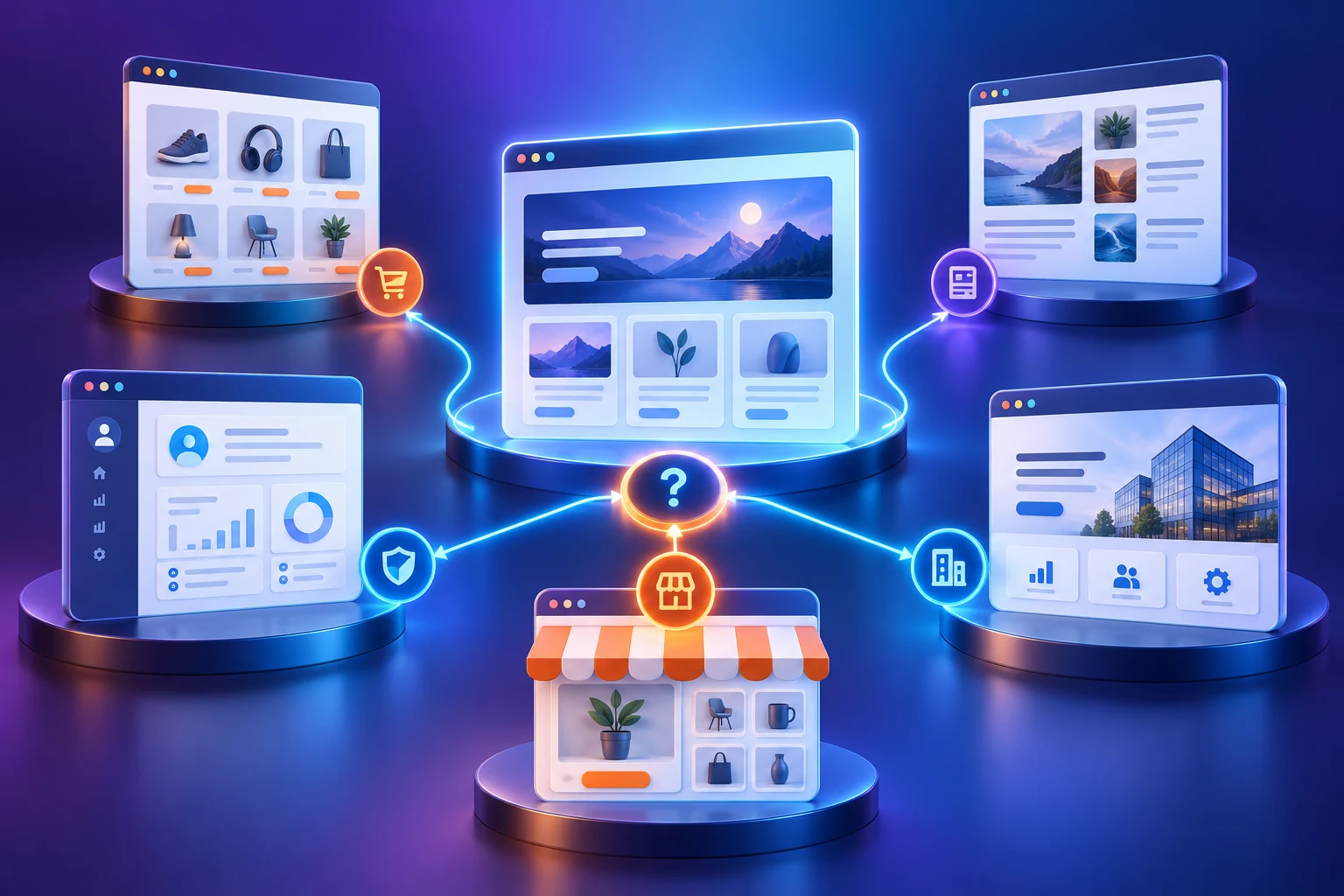
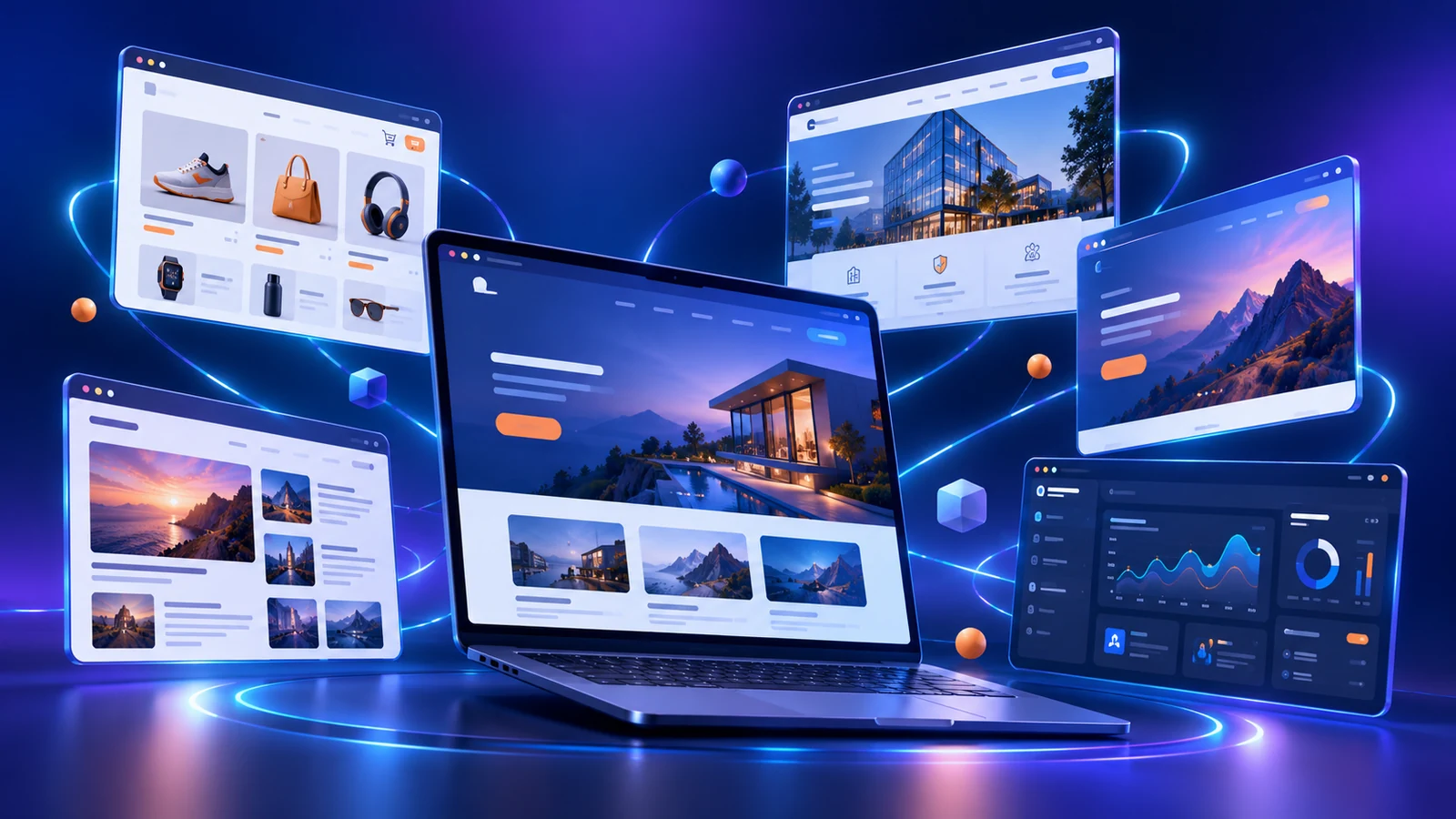
Sites differ not only in design and number of pages. The main difference is in the tasks they solve, the ways they interact with visitors and the required functionality. For one business, a small page with a description of the service and an application form is enough. Another needs a full-fledged online store with a catalog, shopping cart and payment. The third requires a web service in which users can register, work with data and perform certain actions.
That is why before development it is important to understand what types of sites there are and how they differ. The choice of format affects the project structure, scope of work, methods of promotion and opportunities for further development.
For example, a landing page may be suitable to check the demand for one service. For a company with several areas of activity, a multi-page corporate website is more convenient. If you need to sell products online, you should consider an online store. And if the main value of the project lies in interactive functions and user scenarios, we can already talk about a web application.
It would be a mistake to choose the type of site solely based on the appearance of the example you like. A beautiful landing page is not always able to replace a multi-page resource, and a complex portal may be redundant for a small company.
To choose the right solution, you first need to answer several questions: what task should the site perform, who will use it, what content is planned to be posted and what actions should the visitor take.
It is also worth considering the prospects for the development of the project. If today a company only needs a presentation of services, but in the future a catalog, personal accounts and integrations are planned, it is advisable to think through the architecture in advance. This does not mean that you need to implement all the features at once. It is important not to create technical restrictions that will hinder further development.
In this article, we will look at the main types of websites: landing pages, business card sites, corporate websites, online stores, catalogues, blogs, portfolios, information portals and web services. Let's figure out who they are suitable for, how they differ, and how to determine the optimal format for business.
It is important to understand that this classification is conditional. One project can combine the functions of several types of sites. For example, a corporate website can include a blog, a product catalog and a section with cases. Therefore, it is more correct to consider the listed formats as a starting point for design, and not as rigid technical categories.
At the same time, it is useful to distinguish between the format of the site and its technical implementation. A landing page describes a way to present a single offer, not a specific content management system. A corporate resource can be built on a CMS, and a web service can include public information pages. These concepts answer various questions: for whom and why is a website being created, what structure it has and what functions it performs.
The more accurately the expected visitor actions are defined, the easier it is to choose the appropriate format. If a person needs to quickly submit a request, complex navigation can get in the way. If he is comparing dozens of products, one advertising screen will not be enough. Therefore, it is useful to analyze tasks before choosing references and design.
The main rule: you need to choose not the most complex or fashionable type of site, but a solution that meets business objectives, audience needs and development plans.
2. Landing page, business card website and corporate website: what is the difference
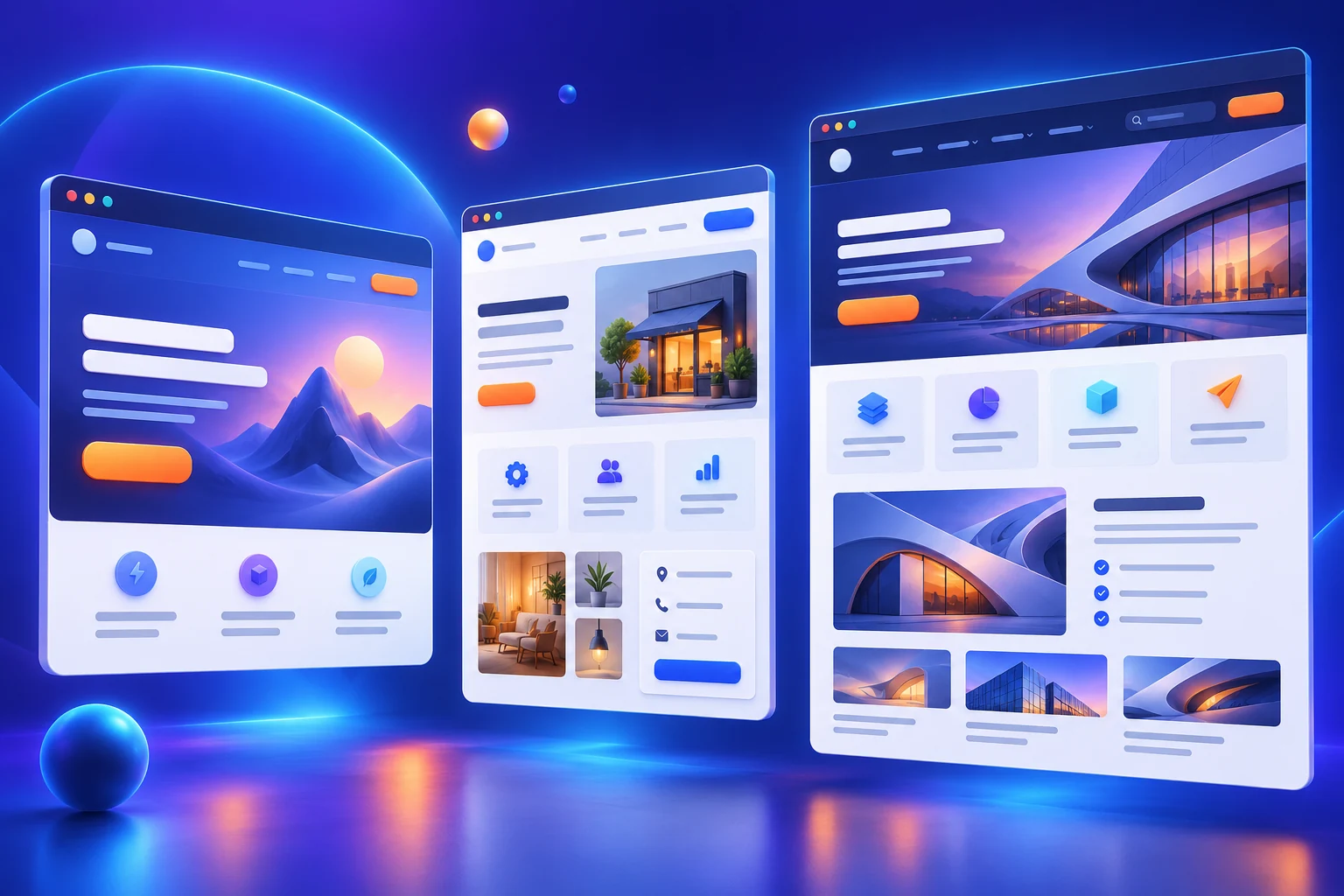
Landing, business card website and corporate website are often considered as similar solutions. All three formats can represent a company and help receive appeals. However, their structure and capabilities differ.
A landing page, or landing page, is usually dedicated to one offer, product, service or specific action of the visitor. Its task is to consistently explain the value of the offer and lead a person to the target action: sending an application, recording, registering or proceeding to purchase.
The landing page structure is built around one scenario. The page may contain the first screen with the offer, a description of the benefits, product features, work stages, answers to questions and a feedback form. Each subsequent block helps the visitor make a decision.
A landing page is especially appropriate for a separate advertising campaign, launching a new product, promoting a specific service, or testing demand. At the same time, the landing page does not necessarily exist separately: it can be part of a large corporate website.
The main limitation of the landing page is its relatively narrow structure. If a company needs to present several areas in detail, post a large portfolio, maintain a blog and develop organic search for many thematic queries, one landing page may not be enough.
Business card website is a compact representation of a specialist, small company or project. It typically contains information about activities, services, benefits and contacts. Such a site helps a person quickly understand who offers the service and how to contact the provider.
Unlike a landing page, a business card website is not always focused on one specific offer. His task is often to provide a general representation of the company or specialist.
A business card website is suitable for private specialists, small service companies and projects that do not yet need a complex structure. It can be either one-page or consist of several small pages. The defining feature here is the purpose, and not the strict number of URLs.
The corporate website presents the company in more detail. It may contain separate pages for services, information about the team, portfolio, cases, vacancies, news, blog, contacts and other sections.
This format is convenient when a business operates in several directions and it is necessary to cover each of them. The structure allows you to create separate landing pages for services and information materials, which is important for the development of search traffic.
The corporate website often becomes the main digital platform of the company. It helps organize information, maintain a unified positioning and connect different marketing channels.
Unlike a small business card, a corporate website requires more careful design of navigation, section structure and content management system.
Thus, a landing page is suitable for a focused offer, a business card website is suitable for a compact introduction to the company, and a corporate website is suitable for a full presentation of the business and its directions.
But these formats are not mutually exclusive. For example, a company can use a corporate website as the main platform and create separate landing pages within it for advertising, promotions or new products.
When choosing, it is useful to take into account not only the current volume of information, but also how often it will be updated, how many areas are planned to be developed, and what audience requests the site should cover.
For example, a local specialist can start with a compact business card that contains a description of services, experience, answers to frequently asked questions and contacts. If separate directions and detailed cases appear later, the site can be developed into a multi-page structure. A company running a short-term campaign for a single product may benefit from a separate landing page with a specific offer.
When choosing, it is also important to determine where visitors will come from. Ad traffic is often directed to a page that matches a specific ad. Search visitors may want more detailed information and related pages. In both cases, the text, navigation, and forms must meet audience expectations. If a person needs to independently explore several services, the corporate structure helps move from a general description to the right direction.
Website development on WordPress may be suitable for projects for which it is important to manage pages and publications through the admin panel. A specific platform should be selected after discussing the requirements, and not just by the name of the format.
3. Online store, catalogue, blog and portal: main differences
Not all sites need to talk about the company and accept applications. Some projects should help users choose products, search for information, compare offers, or regularly learn new materials.
The online store is designed for online sales. Its basis is a product catalog, but the most important difference from a regular catalog website is a full-fledged purchase process.
In the online store, the user may have access to product cards, characteristics, filters, comparison, shopping cart, ordering, payment and delivery options. The specific functionality depends on the business model and platform chosen.
For a store, easy navigation, clear purchasing conditions, correct operation of balances and prices, as well as order management are important. As the project grows, integrations with accounting systems, CRM and delivery services may be needed.
The catalog site presents a range of products or services, but does not necessarily support online payment and a full shopping cart. Instead of making a purchase, a visitor can send a price request, leave a request, or contact the manager.
This approach is often suitable for companies with custom pricing, complex equipment, bulk supplies, or products that require prior approval.
For the user, the catalog helps to explore the range and characteristics. For business - structure proposals and receive substantive requests.
Blog - a website or section with regularly published materials. Its main task is to disseminate useful information, expert explanations, news or opinion pieces.
A blog can exist independently or be part of a corporate website. For businesses, it helps answer questions from potential clients, reveal professional expertise, and attract audiences for information search queries.
However, publishing articles alone does not guarantee traffic growth. The result depends on the quality of materials, compliance with search intent, technical condition of the site and competition.
The information portal combines a large volume of thematic materials and can have a complex section structure, search, filtering, user functions and several types of content.
Unlike a small blog, a portal is often designed for many user scenarios and constant expansion of information. Examples include industry resources, help systems, educational platforms, and topical communities.
When choosing between a store, catalog, blog and portal, you need to evaluate the main user action. Should he buy a product, request a quote, read a material, or find information among a large number of sections?
It is also important to consider the load on content management. An online store needs updating of product data, a blog needs regular editorial work, and a large portal needs a well-thought-out information architecture.
One project can combine all these tools. For example, an online store can include a blog with useful articles, and a corporate website for a manufacturing company can include an equipment catalog and an information section.
Before choosing between a catalog and a store, it is worth describing the entire order path. If the buyer must independently select an option, provide an address, pay and receive confirmation, the corresponding store functions will be needed. If conditions depend on volume, region, configuration or negotiations with the manager, a catalog with a request form may more closely correspond to the actual sales process.
You need to decide in advance who is responsible for the content of the catalog or store. Often you will need to regularly update names, descriptions, photos, availability and delivery conditions. If this data is already maintained in another system, it is important to understand whether it needs to be transferred manually or synchronized. Such organizational details influence the design of the project no less than the appearance of product cards.
A blog and information portal also requires an editorial process: selecting topics, checking facts, preparing materials, and updating outdated publications. This helps avoid creating a section that, after launch, will be left without new materials and a responsible owner.
Main types of sites and their tasks
- Landing - promoting one offer and receiving targeted requests.
- A business card website is brief information about a specialist or small company.
- Corporate website - presentation of business, services, team and projects.
- Online store - selling goods with online ordering.
- Catalog website - demonstration of assortment and collection of requests from customers.
- Blog - publication of useful articles, news and expert materials.
- Portfolio website - presentation of works and professional experience.
- The information portal is a large structured resource with materials and search.
- Web service - performing user tasks through an interactive interface.
- Educational platform - organization of training, materials and interaction with students.
4. Portfolio, web services and special types of sites
In addition to the most common formats, there are sites focused on specific professional tasks or complex interaction with users.
A portfolio website helps present completed work and show the approach to projects. It is often used by designers, photographers, architects, developers, studios and creative professionals.
The most important part of a portfolio is not the number of beautiful images, but a clear description of the work. It is useful for the visitor to know what problem was solved, what was done and what role the specialist or team performed.
A portfolio can include galleries, project cards, category filters, service information, and a contact form. For companies, the portfolio often becomes a separate section of the corporate website.
A web service differs significantly from a regular information site. Its main value lies in functionality: the user comes not only to read information, but also to perform certain actions.
Examples could be a reservation system, a personal account, an order processing platform, an online calculator, an application management service, or an internal system for employees.
Such projects often require registration and authorization, data storage, delimitation of access rights, interaction with APIs and integrations with other services.
Web service development usually involves more detailed development of user scenarios, business logic and security requirements.
Educational platforms form a special category. They can provide learning materials, personal accounts, tests, assignments, and learning tracking tools. In terms of technical organization, such projects are often close to web services.
There are also event websites: they talk about a conference, exhibition, concert or other event. Depending on the task, the event website may include a program, information about participants, a registration form, ticket sales, or broadcasts.
Community sites and forums are designed for users to communicate, post messages, and share experiences. Moderation, user rights, and spam protection are especially important to them.
Advertisement services and marketplaces combine offers from different sellers or performers. Such platforms typically require multiple user roles, a catalog of offerings, search, ratings, and engagement processes.
It is important not to confuse an online store of one company and a marketplace with several independent sellers. They may look similar, but have significantly different business logic.
For internal tasks of companies, corporate portals and closed web applications are created. They can help manage documents, processes, tasks, approvals, and employee access to information.
Thus, the variety of sites is determined not only by the topic, but also by the complexity of user interaction.
If the site mainly presents information and collects requests, you can consider traditional solutions based on a content management system.
If the project requires complex logic, personal accounts, integrations and non-standard scenarios, individual development of a web service may be necessary.
In this case, the choice of technology should be made after determining the requirements. Not every corporate website needs its own software framework, and not every web service makes sense to implement on a universal CMS.
The more roles and scenarios a service has, the more important it is to describe user rights and rules for working with data in advance. For example, the customer, contractor, and administrator can see different information and perform different actions. For such projects, it is useful to think separately about registration, access recovery, notifications, error handling, and user support.
It is often wise to introduce complex features in stages. You can first define a minimum set of scenarios that will test the basic business idea, and then expand the system based on operational results. This approach helps focus initial development on the features you really need, rather than turning your wish list into an endless project.
If the main task remains publishing information and receiving requests, there is no need to automatically complicate the site with authorization and individual logic. If users must regularly work with data, and the processes cannot be correctly carried out through ordinary pages and forms, it is worth evaluating the format of the web service. Web services development in Python may be considered for projects with custom scripts and integrations once requirements have been agreed upon.
5. How to choose the type of website for your business
It’s better to start choosing the type of site not with the design or the name of the platform, but with business goals.
The first question is what task should the future resource perform. If you need to receive applications for one specific service, a landing page may be suitable. If you need to present your company and several areas in detail, a corporate website is more convenient. If your main goal is online sales, it’s worth exploring the possibilities of an online store.
The second question is who will use the site. A potential buyer, a corporate customer, an existing client and a company employee expect different functions from the interface. Therefore, it is important to imagine the main user scenarios before development begins.
The third criterion is the quantity and structure of content. Multiple screens with one offer and a large catalog with hundreds of products require different architectures. The more information there is, the more important it is to think through navigation, search, filtering and content management system.
The fourth factor is the need for integration. For example, if the site must interact with a CRM, warehouse system, payment service or internal database, it is better to take these requirements into account at the design stage.
The fifth factor is promotion. For an advertising campaign, one well-prepared landing page may be enough. To consistently work with organic search across different business lines, a multi-page structure with separate services and information materials is often useful.
The sixth criterion is further development. A business can start with a small project and then add new services, a directory, a blog or functional sections. Therefore, it is advisable to understand how expandable the chosen solution is.
The seventh question is the budget and cost of support. When evaluating a project, you need to take into account not only the initial development, but also site placement, technical support, updates, content, and future improvements.
You shouldn’t choose the cheapest option based solely on the starting price. An architecture that is too limited may require significant redesign as the business evolves.
But even the most complex project is not always justified. If the task is tested by a simple landing page, it may be irrational to create a large platform at once.
The eighth criterion is ease of management. It is important to understand in advance who will publish articles, change prices, add products and update information. Many commercial sites benefit from a clear administrative panel that does not require developer involvement with every change.
The ninth factor is technical requirements: loading speed, security, mobile adaptability, interface accessibility and resistance to the expected load. These qualities are needed by different types of sites, although the ways in which they are implemented may vary.
Separately, the features of the project should be taken into account. For example, a corporate website with a product catalog may not need a shopping cart, but require complex filtering. And the service registration system may look like a regular website, although inside it will contain the functionality of a web service.
It's helpful to create a short list of must-haves and future opportunities. Such a document helps to separate truly necessary features from additional wishes.
Before determining the development technology, it is advisable to agree on the structure, basic user scenarios, page composition and content management principles.
The final choice can be combined. The company is able to use a corporate website, separate advertising landing pages and clients’ personal accounts, united by a common system.
The right type of website is one that solves current problems without undue complexity and allows you to develop the project in accordance with business plans.
It is practical to divide the requirements into three groups: what is absolutely necessary for launch, what is desirable to be added later, and what remains a hypothesis. For example, for the first stage, pages of basic services and an application form may be required, and a personal account is only a possible direction of development. This helps to compare solutions based on real benefits and not judge the project solely on the length of the technical list.
It's also helpful to assign people responsible for content and support. If no one updates products, news or schedules, even a properly designed section will quickly lose relevance. Before starting work, it is worth collecting available texts, photographs, process descriptions and integration requirements. Missing materials can be included in the preparation plan so that they do not become an unexpected obstacle before launch.
Finally, it is important to define the criteria by which the result will be assessed. This could be the correct publication of information, ease of filling out an application, successful data synchronization, or the ability of an employee to independently update pages. Specific criteria depend on the purpose of the site and should be clear to the business and development team.
6. Which site to choose: final recommendations
There is no universal website format that is equally suitable for all companies. The choice depends on what the business is offering to the audience, what actions visitors need to perform, and how the project will develop.
If you need to present one service or support a specific advertising campaign, it is worth considering a landing page. Its strength is a focused offer and a clear user path to the target action.
A small specialist or local company for whom it is important to place basic information and contacts may be suitable for a business card website. However, if the number of services is growing, you should evaluate the advantages of a multi-page structure in advance.
For a company with several directions, a team, a portfolio and plans for search engine promotion, a corporate website is often a logical solution.
If a business sells goods online, it is important to figure out whether a full-fledged online store with ordering is required or whether a catalog with the ability to send a request is enough.
For projects where the main value comes from features rather than information pages, a web service may be required. Booking systems, personal accounts and automation platforms should be designed taking into account business logic and user scenarios.
If the task is to regularly publish useful materials, you can develop a blog or a thematic information resource. Such a section can complement a corporate website and help the audience find answers to their questions.
It is equally important to understand that a website is not only the moment of launch. The result depends on the relevance of the content, user friendliness, technical support, analytics and selected promotion methods.
Therefore, before ordering development, it is useful to prepare a short brief: talk about the company, target audience, main tasks, required functions and examples of suitable solutions.
Based on this data, it is already possible to determine the structure, select technologies, estimate the amount of work and draw up a realistic project plan.
Bravix develops WordPress sites and custom web services. We can help determine which format best suits the task at hand and discuss the design of the project before implementation begins.
If you don’t yet know whether you need a landing page, a corporate website, an online store or a web application, start by describing your business problem. It is she who should determine the technical solution.
The main takeaway is simple: different types of websites are created for different scenarios. It is necessary to choose not by the name of the format, but by how the future resource will help the user obtain the necessary information, take an action, or solve a specific problem.
Before starting, you can go through a short test: formulate the main task of the site, describe the main audience, list the required actions of the visitor and note the data that will need to be updated regularly. Then you should decide whether you need online payment, a personal account, filtering or integration with other systems. The answers will help you differentiate between needed functionality and ideas for the future.
If there are few requirements yet, this does not prevent you from starting with consultation and elaboration of the structure. As the processes are refined, it will become clearer whether a landing page is enough or whether the company needs a corporate website, catalog, store or a separate web service. It is important to record this decision before implementation so that the project is based on a business problem and a clear development plan.