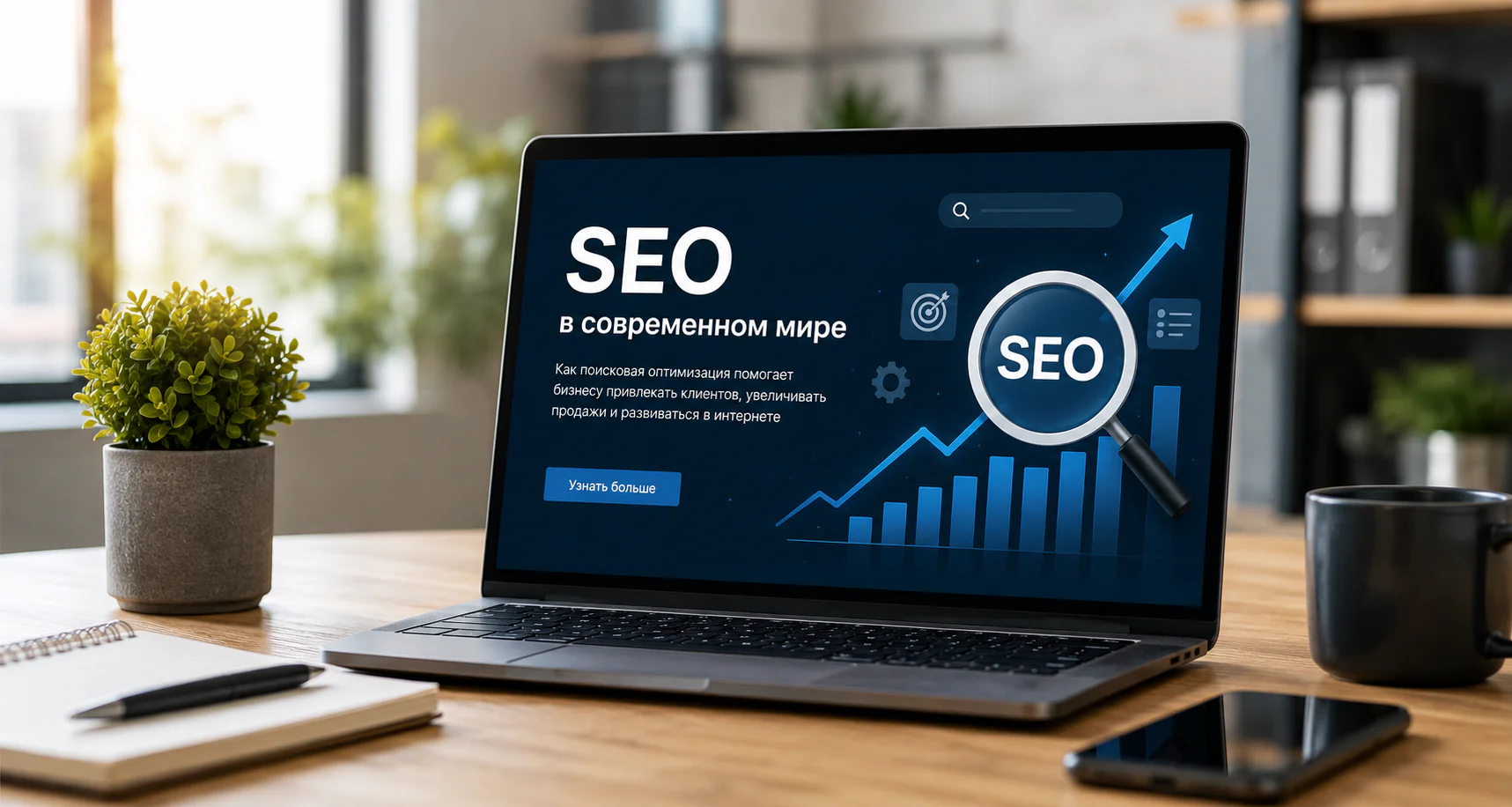
1. Why SEO is necessary for modern business.
Today the Internet has become one of the main sources of information about goods, services and companies. Before contacting an organization, ordering a service, or making a purchase, a potential client often begins by searching for information. He enters a query of interest, compares offers, studies company websites, reads descriptions of services, and only after that makes a decision.
Therefore, the mere fact of having a website is no longer enough. You can create a modern design, tell in detail about the company, place a product catalog and a convenient feedback form, but all this will be of limited benefit if potential customers cannot find the resource through search engines.
This is exactly the problem solved by SEO - search engine optimization of a website. It helps make pages more understandable to search engines and users, improve their presence in search results, and attract an audience that is already interested in certain information, product or service.
On the modern Internet, SEO is not a separate technical setting or simply adding keywords. This is a comprehensive work on the site: its structure, content, speed, technical condition, ease of use, internal links, headings, metadata and the quality of individual pages.
The main value of search engine promotion is the opportunity to meet a potential client at the exact moment when he already has a need. UserThe user independently formulates a request and searches for a solution to his problem. If a company's website appears among the relevant results and contains useful information, the business has the opportunity to turn an organic search into brand awareness, conversion, and ultimately a sale.
SEO is especially important in highly competitive environments. In most commercial topics, the user can choose between tens and hundreds of companies. If an organization has virtually no presence in search, a significant portion of potential demand may go to competitors.
Therefore, search engine optimization becomes a long-term digital asset for a company. By developing a website, a business simultaneously works on its visibility on the Internet, quality of content, ease of interaction with customers and overall competitiveness.
SEO helps a business to be visible precisely when a potential client is looking for a product, service, specialist or solution to their problem. Good optimization turns a website from an ordinary Internet business card into a full-fledged channel for attracting an interested audience.
2. Visibility in search and trust of potential clients.
Search results have long become one of the places a person first meets a company. The user may not know anything about the brand, but see its page while searching for the desired service. That is why the presence of a site for thematic queries affects not only the number of transitions, but also the recognition of the business.
When company pages are regularly encountered by a user for various related queries, the brand gradually becomes familiar. A person can first read an informational article, later open a service page, then study prices or examples of work, and only after several contacts leave a request.
This is especially important for areas where the purchasing decision is not made immediately. When choosing a contractor, expensive service, equipment, software product or professional specialist, the user needs time. He studies the market, compares options and looks for answers to additional questions. A developed website is able to accompany a potential client at almost all these stages.
SEO helps you create pages for different search intents. One user wants to know general information, another compares solutions, a third is looking for a price, and a fourth is ready to order a service. Instead of trying to bring all visitors to one page, you can build a full-fledged site structure in which each page solves a specific problem.
At the same time, trust depends not only on the position of the site. Quality is importantsta, clear structure, up-to-date information, easy navigation, correct display on mobile devices, transparent working conditions, contact information and other elements that allow a person to quickly evaluate the offer.
Search engines also strive to show users useful and reliable pages. Therefore, modern SEO is increasingly linked to the real quality of the resource. Optimizing a website just for the sake of algorithms without taking into account the needs of the visitor becomes pointless: the ultimate goal is not just to get a click, but to ensure that the visitor finds the answer and wants to continue interacting with the company.
Thus, SEO works for both visibility and reputation. The more useful contact points a company creates in search, the higher the likelihood that at the time of making a decision the user will remember it.

3. Attracting targeted traffic, customers and sales.
One of the main benefits of SEO is the nature of the audience it can attract. It is not by chance that a person comes from a search; before doing so, he independently formulated a specific request. This means that the user already has an interest, question, problem or need.
For example, a person may be looking for repair of a certain equipment, legal advice, home construction, website development, equipment supplier, or a specific product. If a company's page matches this request and convincingly answers the user's need, the likelihood of further contact becomes much higher.
At the same time, search demand is not limited to the most obvious keywords. In any developed topic, there are hundreds and thousands of query options: information questions, product categories, service names, characteristics, comparisons, prices, geographic queries and more specific formulations.
Therefore, a competent SEO strategy involves the development of a large number of useful landing and information pages. Instead of promoting the site solely on a few high-frequency phrases, the company gradually expands its thematic presence and receives clicks on a large number of relevant queries.
Information content can also participate in attracting customers. A person does not always start his search with the phrase “order” or “buy.” First he can search for toolproduction, comparison, explanation of a term or recommendations for selection. A useful article introduces him to the company before he finally decides on a purchase.
As a result, the site turns into a kind of digital funnel. Some pages attract people at the stage of getting to know the problem, others help choose a solution, others answer commercial questions, and pages for services and products allow you to go directly to the request or purchase.
Search engine optimization is especially valuable because the results of accumulated work can be used for a long time. A good page is capable of receiving search traffic after publication if it remains high-quality, relevant and accessible to search engines. At the same time, positions are not constant: competitors appear, demand changes, algorithms are updated, so the results need to be monitored, and the content and technical part of the site must be improved.
The main tasks that SEO helps businesses solve:
- Increasing website visibility in search engines
- Attracting potential clients for targeted queries
- Increasing the number of organic transitions to the site
- Promotion of individual products, services and categories
- Expanding the company's presence on thematic queries
- Engaging audiences at different stages of decision making
- Increasing company and brand awareness
- Creating additional points of contact with potential clients
- Development of information section and expert content
- Improving the structure and usability of the site
- Identify technical issues that are preventing indexing
- Improving the presentation of pages in search results
- Reducing business dependence on one source of Internet traffic
- Getting a long-term effect from the created pages and content
- Sales support due to the company's constant presence in the search
4. Why technical website optimization is so important.
Even high-quality content may not reach its potential if the site has serious technical problems. Therefore, modern SEO necessarily includes technical optimization.
The search engine must be able to locate the page, retrieve its content, correctly interpret the information, and add the document to the search index. Errors at any of these stages can limit the visibility of the site.
Technical tasks include monitoring page indexing, setting up robots.txt and Sitemap files, correctness of internal links, working with duplicates, redirects and non-existent pages. It is necessary to ensure that important materials are accessible to search robots, and unnecessary technical pages do not create unnecessary problems.
The structure of the site is of great importance. The user must understand where he is and how to get to the section of interest. Similar to a search engine, it is easier to work with a resource when the pages are logically interconnected, have clear addresses and are divided into thematic categories.
Special attention is paid to page titles and their descriptions. They help the search engine and the user understand the content of the document. A good title should accurately reflect the topic of the page, and the description should succinctly convey its value. How clearly a page is presented in search results may influence a user's decision to visit the site.
Mobile version is also importantiya. A significant part of the Internet audience uses smartphones, so the resource should remain convenient regardless of screen size. The text should be easy to read, the controls should work correctly, and the user should not have to constantly zoom into the page or face awkward navigation.
Website performance should also not be viewed solely as a technical characteristic. Slow loading times irritate visitors and can prevent them from exploring pages. Therefore, optimization of images, intelligent work with scripts, stability of display of elements and overall speed of the resource are part of a high-quality user experience.
Safety is equally important. The use of a secure connection, timely software updates and elimination of vulnerabilities are necessary, first of all, for the visitors themselves and the business.
Technical SEO ultimately creates the foundation for all future work. You can regularly publish articles and create landing pages, but if search engines have trouble crawling and indexing your site, the effectiveness of your content strategy will be limited.
Therefore, SEO audit and regular technical control are especially important for large and developing projects. As new pages appear, the structure becomes more complex, redirections, deleted materials, duplicates and other situations arise that need to be controlled.
5. Why SEO is an investment in long-term business development.
Search optimization is important to perceive not as a one-time service, but as systematic work on a company’s digital asset. The site develops along with the business: new services, products, directions, regions of work, customer questions and information materials appear. All these changes create new opportunities for search engine promotion.
One of the key differences between SEO and many short-term methods of attracting an audience is the cumulative nature of the work. Created pages, improved structure, internal links, optimized categories and quality articles do not disappear after the end of the advertising campaign. They remain part of the site and continue to form its information value.
This doesn't mean organic traffic is free. To achieve results, you need specialists, content, development, analytics and constant development of the resource. However, the company invests not only in individual user transitions, but also directly in its own Internet platform.
Over time, the site can cover more and more search scenarios. First, the company optimizes the main services, then creates pages for individual areas, publishes answers to popular questions, develops a blog, adds cases, instructions, comparisons and other useful materials. A thematic base is gradually being formed that can attract audiences for a variety of requests.
SEO also gives businesses useful information about demand. Analiz of search queries allows you to see what interests users, what problems they are trying to solve, what characteristics of products they consider important and what questions they ask before purchasing.
This data can be used not only for promotion. They are able to suggest topics for new materials, help improve descriptions of services, influence the structure of the catalog and even give ideas for developing the company’s offer.
It is especially useful to combine SEO with analytics. It is not enough to look only at the number of visitors. Businesses need to understand which pages bring the target audience, which queries produce results, where visitors leave requests, and which areas require improvement.
Based on this data, SEO transforms from a set of assumptions into a manageable process. The company forms a hypothesis, makes changes, monitors the result and decides on further actions.
At the same time, search engine promotion takes time. Search engines must detect the changes, process the pages, and rank them against other results. Therefore, it is wrong to expect an instant effect after publishing several texts.
A long-term approach is much more sustainable. Instead of trying to find one secret way to quickly take the first positions, a business consistently improves the resource: eliminates technical errors, develops the structure, creates truly useful content, analyzes audience behavior and updates outdated pages.
As a result, SEO becomes part of the overall strategy of Internet marketing and company development, and not a separate task that only needs to be completed once.
6. Conclusion. SEO as a necessary development tool on the modern Internet.
In today's digital landscape, it's not enough to just create a website and expect potential customers to discover it on their own. Competition for users' attention is high, and search remains one of the most important ways to find information, compare offers and choose the right solution.
SEO helps a company take its place in this process. Its task is not only to increase positions for individual requests. Full search engine optimization makes a website clearer for search engines, more convenient for visitors and more useful for potential clients.
Competent SEO combines several areas: technical optimization, working with structure, creating quality content, analyzing search demand, improving pages and constantly monitoring results. It is an integrated approach that allows you to gradually increase the presence of a business in search.
The quality of the content is of particular importance. Modern optimization should not turn a page into a set of artificially repeated keywords. The material should first of all solve the user’s problem: answer his question, help him make a choice, explain a complex topic, or provide necessary information.
For business, this means changing the very approach to the site. The resource ceases to be a static business card and becomes a constantly evolving platform. New services, useful articles, answers to questions, cases, instructions and other materials appear on it, cat, which simultaneously help customers and expand the company's search presence.
SEO also reduces the risk of becoming completely dependent on one channel to reach your audience. A company can use contextual advertising, social networks, recommendations, marketplaces, email marketing and other tools, while simultaneously developing its own organic traffic. The more diverse the sources of requests, the more stable the business marketing system.
It is also important to understand that SEO does not guarantee constant first place in search results. Competitors are evolving, search algorithms are changing, new technologies are emerging, and user behavior is changing. Therefore, successful optimization is based on constant analysis and improvement.
Companies that systematically work on their website receive much more than just an increase in individual positions. They create an information base, increase awareness, strengthen audience trust, better understand customer needs and form a long-term channel of interaction with the market.
This is why SEO remains an important tool for modern business. As people use search to obtain information, select products, and find artists, it will be important for companies to be present where that demand occurs.
It is better to start search engine optimization not when the site has not received organic traffic for several years, but at the stage of its development or development. Correct structure, technical basis and content strategy allows you to initially create a resource with potential for further growth.
Ultimately, the goal of SEO is simple: help the right person find the right page at the right time. When this task is solved efficiently, both sides win - the user receives the necessary information faster, and the business gets the opportunity to turn search interest into familiarity with the company, trust, referral and sale.